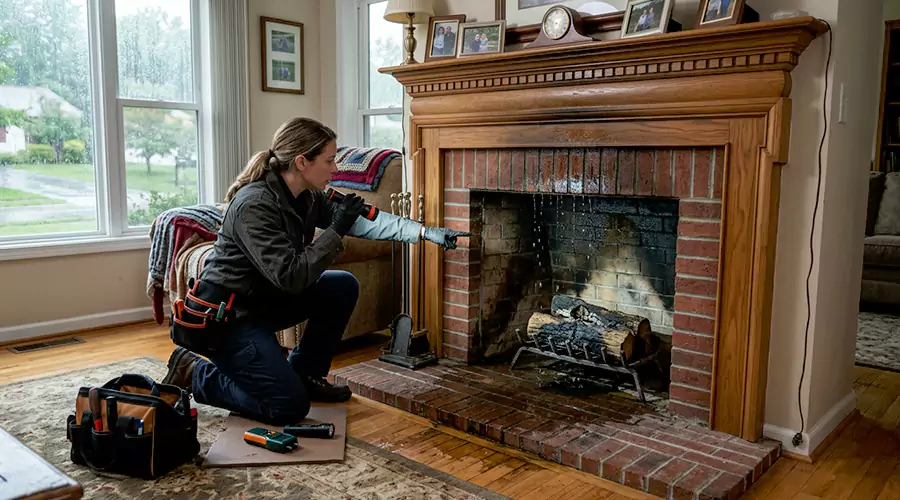
Why Is My Fireplace Leaking Water
Water in your fireplace is not normal. Identify whether the cap, crown, flashing, or masonry is allowing rain inside before damage spreads.




Based on 500+ Reviews

Proudly American
Owned & Operated

A fireplace leaking water usually means rain or moisture is entering through the chimney system rather than the fireplace itself. Common sources include a missing chimney cap, cracked crown, failed flashing, deteriorated masonry, or a damaged chase cover. Water can travel before it becomes visible, so the drip location is not always the entry point.
Water inside a fireplace should not be treated as normal. Repeated moisture can rust metal components, damage mortar, and stain nearby walls or ceilings.
Several chimney components are designed to keep rain out. When one fails, water can move downward until it reaches the firebox.
The chimney cap covers the flue while allowing smoke to escape. If it is missing, bent, rusted, or poorly fitted, rain can fall directly into the chimney. This is one of the first things to check when water appears mainly inside the firebox during rain.
The crown is the sloped masonry surface around the flue. Its purpose is to direct water away from the chimney walls. Cracks can let water penetrate the upper chimney. Moisture may then move through masonry or around the flue before reaching the fireplace.
Flashing is the metal system where the chimney meets the roof. Loose, corroded, or poorly installed flashing can allow roof runoff underneath roofing materials. A flashing problem may create stains on ceilings or walls near the chimney.
Brick and mortar can absorb moisture after years of weather exposure. Cracked joints, spalling brick, and porous masonry can let water move through the chimney structure. Long periods of rain may make this type of leak more noticeable as the masonry becomes saturated.
Prefabricated fireplaces often use a metal chase cover instead of a masonry crown. If the cover rusts, sags, or develops openings, water can enter the chimney chase.
The location and timing of moisture can help narrow the source, although they cannot confirm it by themselves.
| What You Notice | Possible Cause | Useful Clue |
|---|---|---|
| Dripping into firebox | Cap or crown damage | Appears during rain |
| Ceiling stain near chimney | Flashing or roof joint | Moisture beside chimney |
| Damp upper masonry | Crown or mortar failure | Brick stays wet |
| Rust near damper | Water entering from above | Metal remains damp |
| Leak after prolonged rain | Porous masonry | Slow moisture buildup |
If the chimney is leaking water, inspect the entire water-shedding system instead of assuming the visible wet area identifies the defect. Water can travel along masonry or framing before appearing indoors.
Start indoors. Check the firebox, damper area, ceiling, and nearby walls after rainfall. Note whether moisture appears immediately or only after several hours. If the attic is safely accessible, inspect around the chimney for darkened wood, damp insulation, or water tracks.
From outside, use binoculars or a zoom camera to look for:
Do not climb onto a steep or wet roof just to locate the leak.
The repair depends on where water enters. A missing cap may only require replacement. A cracked crown may need sealing, patching, or rebuilding according to its condition. Failed flashing may be resealed when the metal remains sound. Corroded or incorrectly installed flashing usually needs replacement. Deteriorated mortar may require repointing, while damaged bricks may need replacement. A rusted chase cover often needs replacement rather than repeated patching.
Fireplace leak repair should correct the actual water path instead of simply covering the visible interior stain.
Current 2026 estimates place basic chimney leak repair around $160 to $750 on average. More involved work can cost substantially more depending on the failed component.
| Repair Type | Typical 2026 Cost |
|---|---|
| Basic chimney leak repair | $160 to $750 |
| Flashing replacement | $400 to $1,600 |
| Crown work | $400 to $2,200 |
| Larger repairs | Several thousand dollars possible |
Costs rise when water has already damaged masonry, roof decking, liners, or interior finishes. More extensive chimney leak work can reach several thousand dollars depending on the damage involved. Early diagnosis can therefore cost less than waiting for damage to spread.
A small damp spot deserves attention, but some signs call for faster evaluation.
Arrange an inspection when:
Water stains, damp walls, mold growth, and musty odors are recognized warning signs of moisture entering around a chimney. If water is near electrical fixtures or the ceiling is sagging, avoid the affected area until it has been evaluated.
Yes. Not every wet fireplace is caused by rain. Condensation can form inside a cool chimney when warm, moisture-containing air moves through the flue. Rain-related leaks usually worsen during storms or snowmelt. Condensation may appear during dry weather and follow appliance use or temperature changes. The timing of the moisture is therefore an important clue.
Prevention depends on keeping chimney water-control components in good condition.
Useful maintenance steps include:
Avoid relying on repeated layers of sealant as a long-term solution. Sealant cannot correct badly corroded flashing, crumbling masonry, or a failed crown.
A fireplace leaking water usually points to a problem somewhere above the firebox. The cap, crown, flashing, masonry, and chase cover are the main areas to investigate. Start with a safe indoor and ground-level inspection, note when the moisture appears, and address the source before repeated wetting causes more damage. Photograph stains or exterior defects after the next rain so changes are easier to track.
Direct dripping often points to a missing or damaged chimney cap, although crown damage can also allow water to travel downward.
Yes. Failed flashing can allow roof runoff into the structure around the chimney, and that moisture may eventually appear near the fireplace.
Water can damage masonry, rust metal components, and contribute to mold or structural deterioration. The source should be identified.
It is better to identify the cause first, especially if the flue, damper, or masonry may have been affected by water.
Heavy or wind-driven rain can reach small openings in flashing, crown cracks, or deteriorated masonry that stay dry during lighter rainfall.
Water in your fireplace is not normal. Identify whether the cap, crown, flashing, or masonry is allowing rain inside before damage spreads.
